

Section 02 · 7 lectures
Materials and quantum mechanics
The materials the rest of the course uses and the mechanics it needs: how many electrons a crystal holds and how few of them carry current, bonds and bond angles, the classical picture of particles and waves, the experiments that broke it, and the first analytic solutions for free and bound electrons.
ECE 606 Lecture 2.1
Typical semiconducting materials
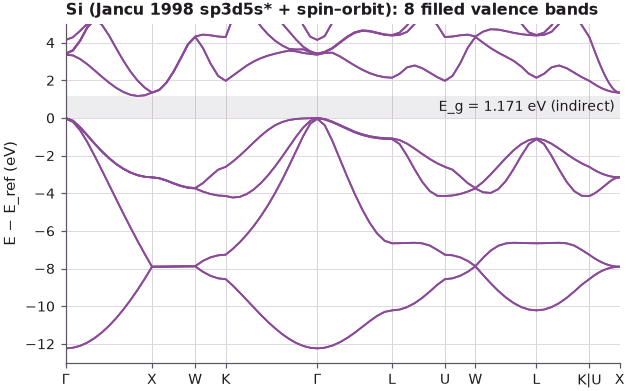
counts atoms, electrons and valence electrons per volume in the open-nemo Si crystal and shows that far fewer electrons carry current than the crystal holds
Interactive
ECE 606 Lecture 2.2
Applications of elemental and compound semiconductors
relaxes a random Si₀.₅Ge₀.₅ crystal with the Keating valence force field and shows its three bond lengths, computes the band edges of Si strained on a SiGe substrate with strain-dependent tight binding
Interactive
ECE 606 Lecture 2.3
Atomic positions and bond orientations
builds the open-nemo Si crystal and compares its pair distribution and bond angles with a crystal of thermally displaced atoms and with a liquid-like random packing at the same density
Interactive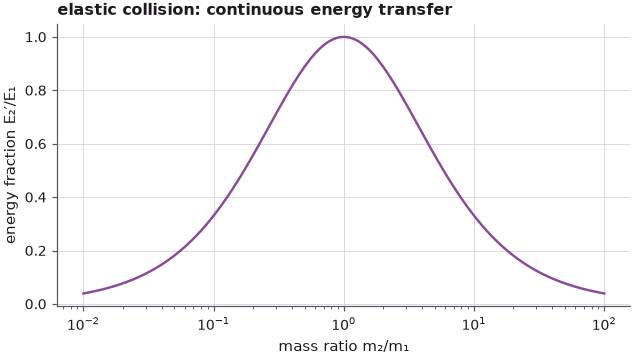
ECE 606 Lecture 4.1
Classical systems: particles, propagating waves and standing waves
follows the lecture's classical catalogue with small calculations: energy transfer in an elastic collision, a Huygens-principle double slit summed point by point and compared with the Fraunhofer formula
Interactive
ECE 606 Lecture 4.2
Strange experimental results: the advent of quantum mechanics
computes the Planck, Rayleigh–Jeans and Wien spectra and checks Wien's displacement and the Stefan–Boltzmann law, counts the standing-wave modes of a cavity, evaluates the 2.725 K cosmic background
Interactive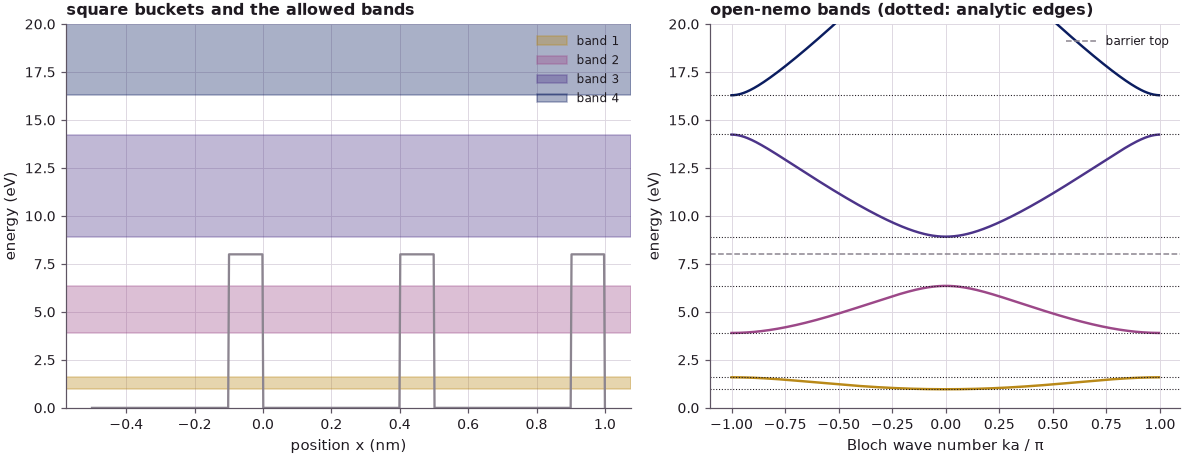
ECE 606 Lecture 4.3
Why do we need quantum mechanics?
builds the lecture's picture of electrons in square buckets as a one-dimensional Kronig–Penney crystal
Interactive
Lecture 5
Analytical solutions for free and bound electrons
solves the three problems of the lecture with open-nemo and compares each with its analytic solution: the dispersion of a free electron on open-nemo's grid against \(\hbar^2k^2/2m\)
Interactive