

Section 09 · 7 lectures
Stress and strain
The continuum theory the atomistic strain models answer to: deformation as strain, internal forces as stress, elastic constants as the response that links them, a thin layer forced onto a substrate, alloys with more than one bond length, and the band edges strain moves.
Lecture 23.1
Theory of stress and strain — introduction
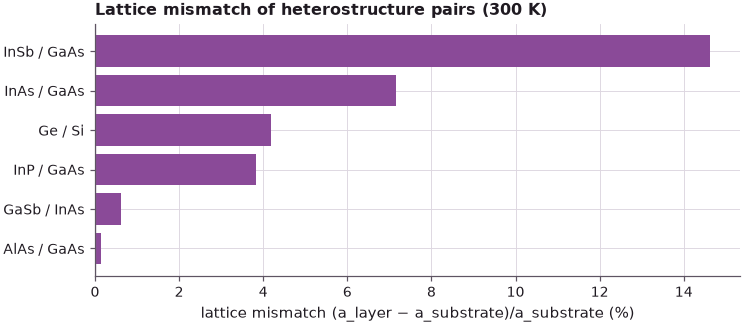
compute the lattice mismatch of common heterostructure pairs from open-nemo's parameter sets, relax a thin InAs film on a GaAs substrate atom by atom with the Keating valence force field (opennemo.models.mechanics)
Lecture 23.2
Theory of stress and strain — deformation: strain
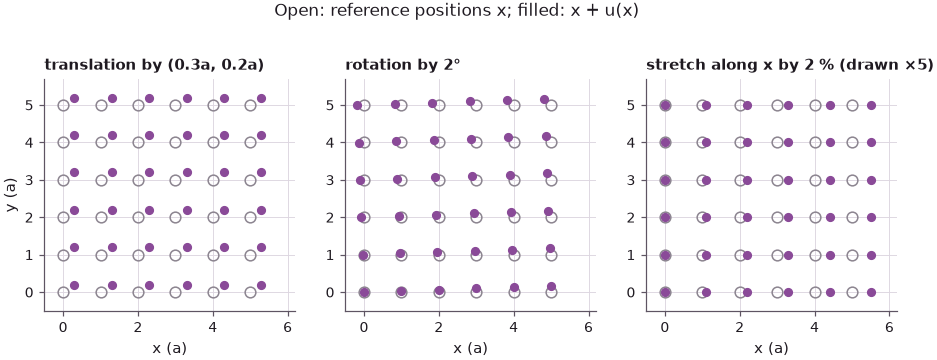
compute displacement gradients of translated, rotated and stretched grids of atoms and see which of them carry strain; build a one-dimensional chain with a strained inclusion and read the local strain off its atoms
Interactive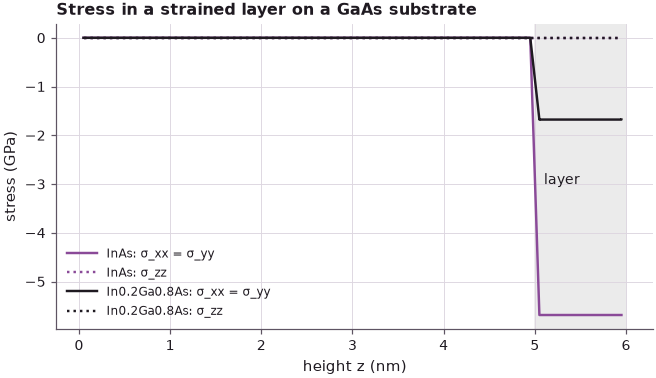
Lecture 23.3
Theory of stress and strain — internal forces: stress
pull a GaAs rod with open-nemo's finite-element elasticity solver (opennemo.solvers.elasticity) and check that the stress is the same at every cut and independent of the cross-section
Lecture 23.4
Theory of stress and strain — material response: elastic constants
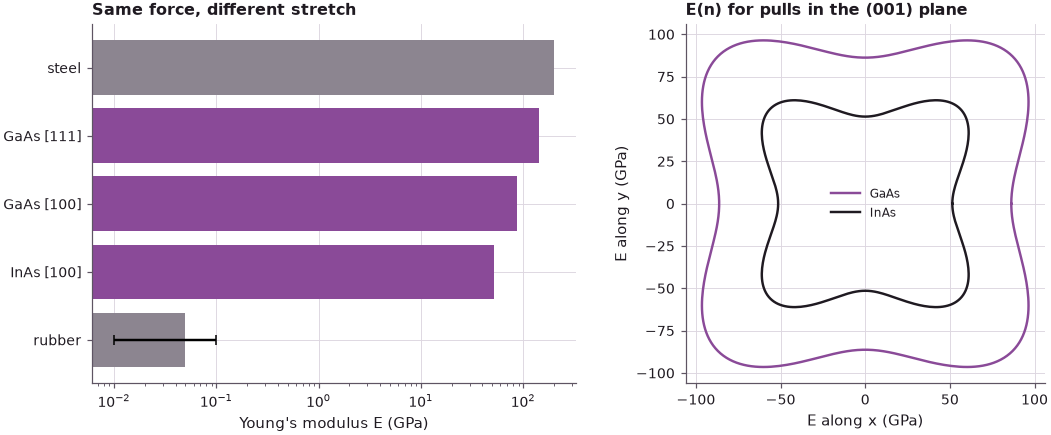
build the 6 × 6 stiffness matrix of GaAs and InAs with elasticity.cubic_stiffness, compute Young's modulus along every direction (the crystal is not isotropic)

Lecture 23.5
Theory of stress and strain — a thin layer on a substrate
split the biaxial strain of InAs on GaAs into volume and shape with kp.biaxial_strain, reproduce the slide's numbers step by step
Lecture 23.6
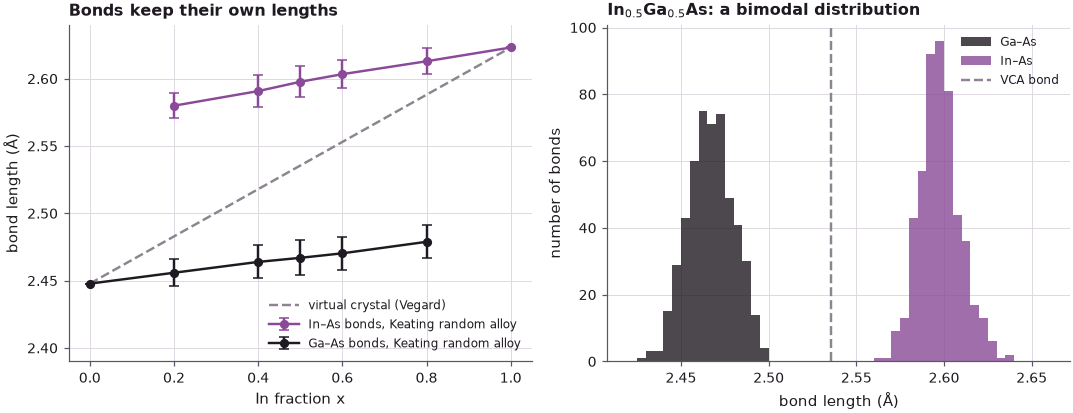
Theory of stress and strain — alloys
interpolate the In$x$Ga${1-x}$As parameters with Vegard's law and compare them with open-nemo's Vurgaftman alloy parameters
Interactive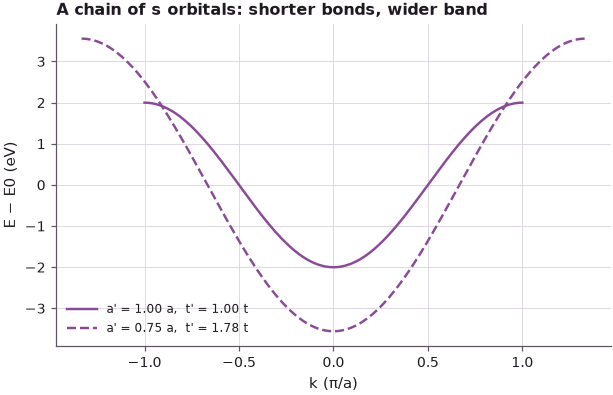
Lecture 23.7
Theory of stress and strain — from strain to band edges
compute the band of a chain of s orbitals at two bond lengths with open-nemo's tight-binding builder, follow the sp³s* bands of silicon as the atoms are brought together, check the pressure coefficient of the GaAs gap
Interactive