

Section 05 · 8 lectures
Introduction to transport
Current through a small device, built up one assumption at a time: scattering against non-equilibrium, a rate equation, coherent tunneling and Landauer, where the voltage actually drops, the transverse modes that turn a 1-D calculation into a 3-D current, and the Tsu-Esaki formula that collects them.

Lecture 10.1
Introduction to transport — scattering experiments versus non-equilibrium transport
compute the scattering quantities \(T(E)\) and \(R(E)\) of a GaAs/AlGaAs double barrier with open-nemo, show how an applied voltage changes them
Interactive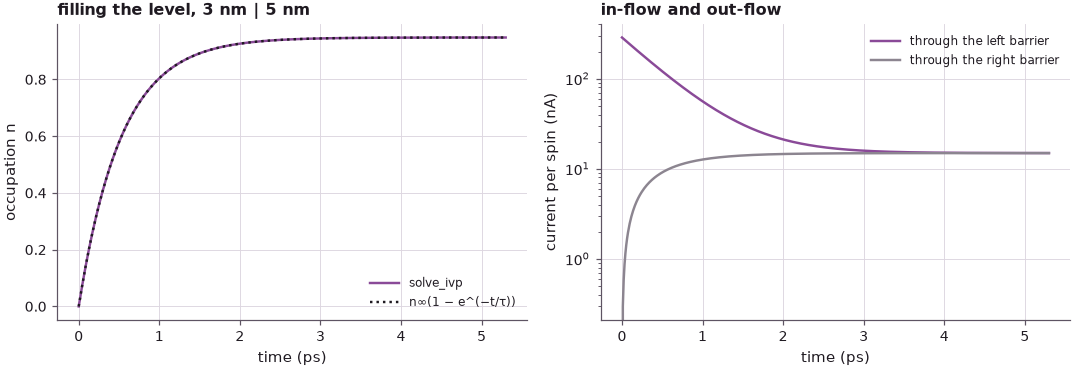
Lecture 10.2
Introduction to transport — a simple rate-equation model of sequential tunneling
take the hopping rates \(\Gamma_L\) and \(\Gamma_R\) of real GaAs/AlGaAs double barriers from open-nemo's resonance solver, integrate the rate equation in time, check the steady-state occupation and current in the lecture's limits
Interactive
Lecture 10.3
Introduction to transport — coherent tunneling in a double barrier and the Landauer picture
implement the Fabry–Pérot formula and compare it with open-nemo's open-boundary transmission, follow the lowest resonance to the particle-in-a-box limit, relate the phase derivative to the round-trip time and the escape rates
Interactive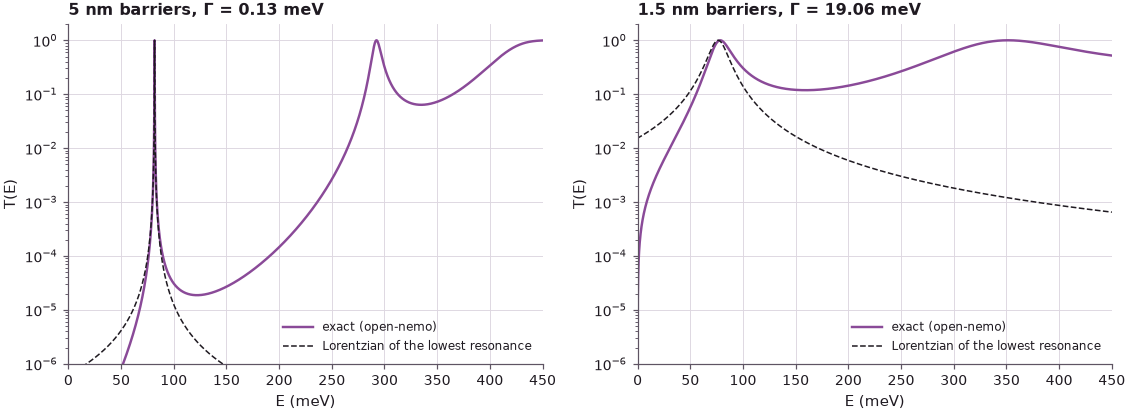
Lecture 10.4
Introduction to transport — sequential versus coherent tunneling
compare the coherent Landauer current with the sequential formula as the resonance broadens, compute the occupation of the well state from open-nemo's NEGF spectral functions and compare it with the rate equation
Interactive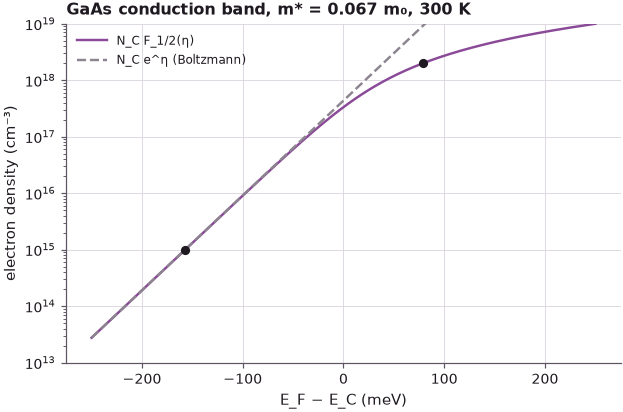
Lecture 10.5
Introduction to transport — free charge interacting with the electrostatic potential: an NIN diode
compute the bulk density–Fermi level relation for GaAs with open-nemo's Fermi–Dirac integral, solve the NIN diode at equilibrium with nemo.semiclassical (Fermi–Dirac statistics and Poisson's equation)
Lecture 10.6
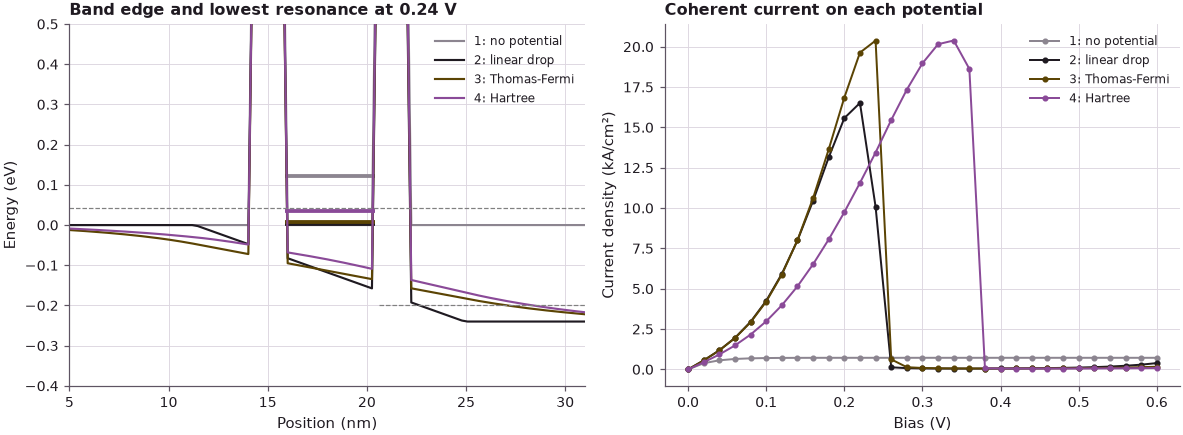
Introduction to transport — where is the voltage drop?
build one AlAs/GaAs resonant tunneling diode with doped contacts and undoped spacers, compute its band profile and I–V at each of the four levels with the same coherent current formula
Interactive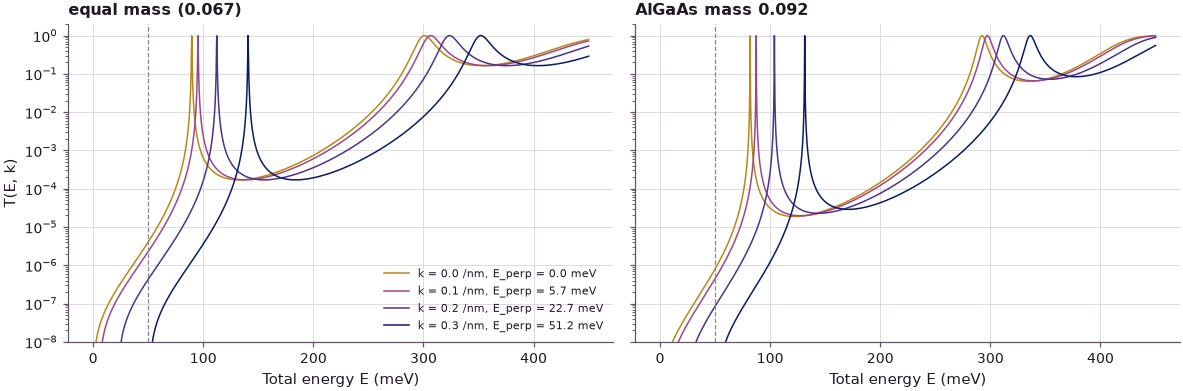
Lecture 10.7
Introduction to transport — from 1D to 3D: transverse degrees of freedom
count the transverse channels of a 1 µm mesa, check that \(\mathbf k_\perp\) only shifts \(T\) rigidly when the effective mass is the same everywhere
Interactive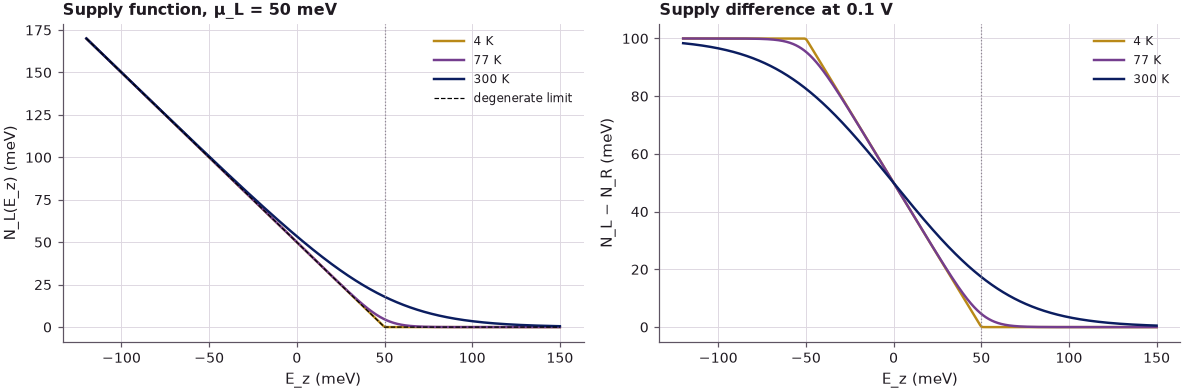
Lecture 10.8
Introduction to transport — the Tsu–Esaki formula
check the transverse kernel \(B_{L,R}\) against a brute-force sum over a \((k_x, k_y)\) grid, check the Tsu–Esaki prefactor against open-nemo's current_density, compute the current of the double barrier both ways