
Section 07 · 7 lectures
Quantum dots and NEMO 3-D
Self-assembled quantum dots and the code written for them: multi-scale design, strain from balls and springs, the sp3d5s* basis, Lanczos for the eigenvalues that matter, the parallelism that makes million-atom dots possible, and the validation that decides whether it works.
Lecture 20
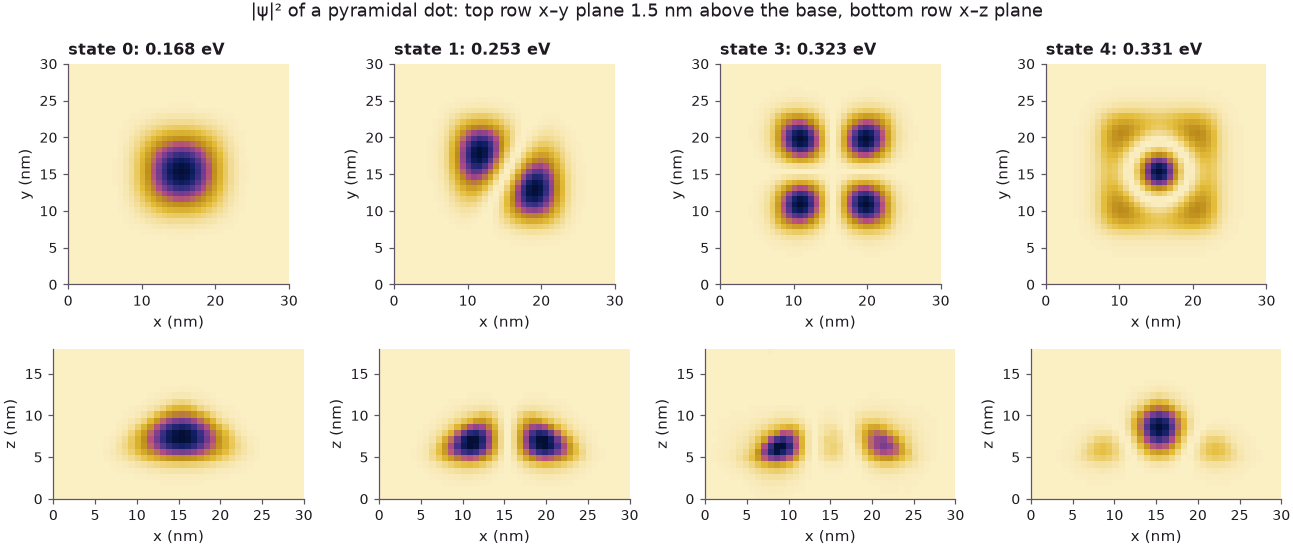
Introduction to quantum dots
- Solve the effective-mass Schrödinger equation of a pyramidal InGaAs-like dot on a 3-D grid with open-nemo, plot its s- and p-like states and compute their optical dipole matrix elements

Lecture 21.1
NEMO 3-D — multi-scale by design
- Count the atoms and Hamiltonian rows of NEMO 3-D-sized domains. - Run the whole NEMO 3-D chain on a small InAs pyramid in GaAs with open-nemo — geometry, Keating relaxation, strain, strained tight-binding Hamiltonian
Lecture 21.2
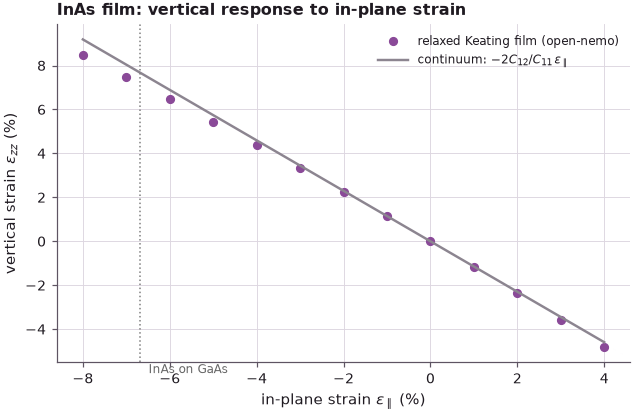
NEMO 3-D — strain: balls and springs
- Compute the elastic constants of Keating's force field and compare them with its closed-form expressions and with measured values
Lecture 21.3
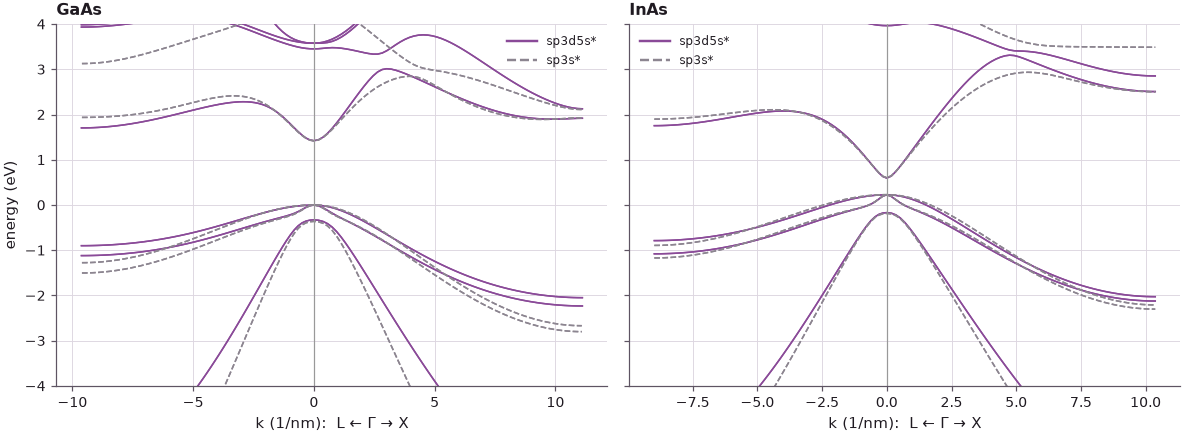
NEMO 3-D — atomistic basis: nearest-neighbour sp3d5s* tight binding
- Count the blocks and non-zeros of an sp3d5s* Hamiltonian, and compare the cost with sp3s*
Lecture 21.4
NEMO 3-D — eigenvalues: Lanczos
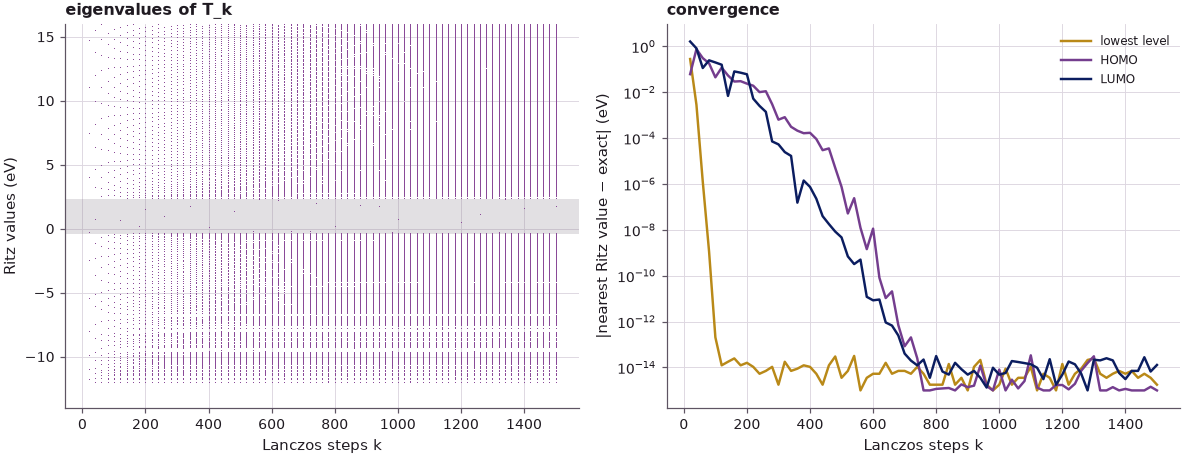
- Redo the storage estimates of the slides. - Write the Lanczos recurrence of slide 6 in a few lines of numpy, apply it to the tight-binding Hamiltonian of a small GaAs nanocrystal built with open-nemo
Lecture 21.5
NEMO 3-D — scaling to large problems: parallel computing
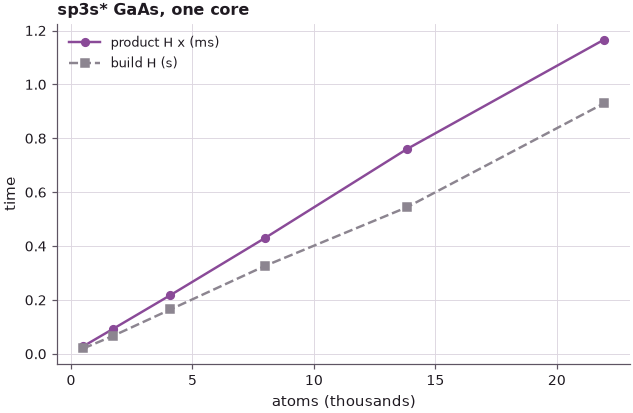
- Time the open-nemo tight-binding Hamiltonian and its product with a vector against the number of atoms, and estimate the memory of a stored sp3d5s* Hamiltonian. - Put the machines of the lecture next to one another
Lecture 21.6
NEMO 3-D — validation: does it work?
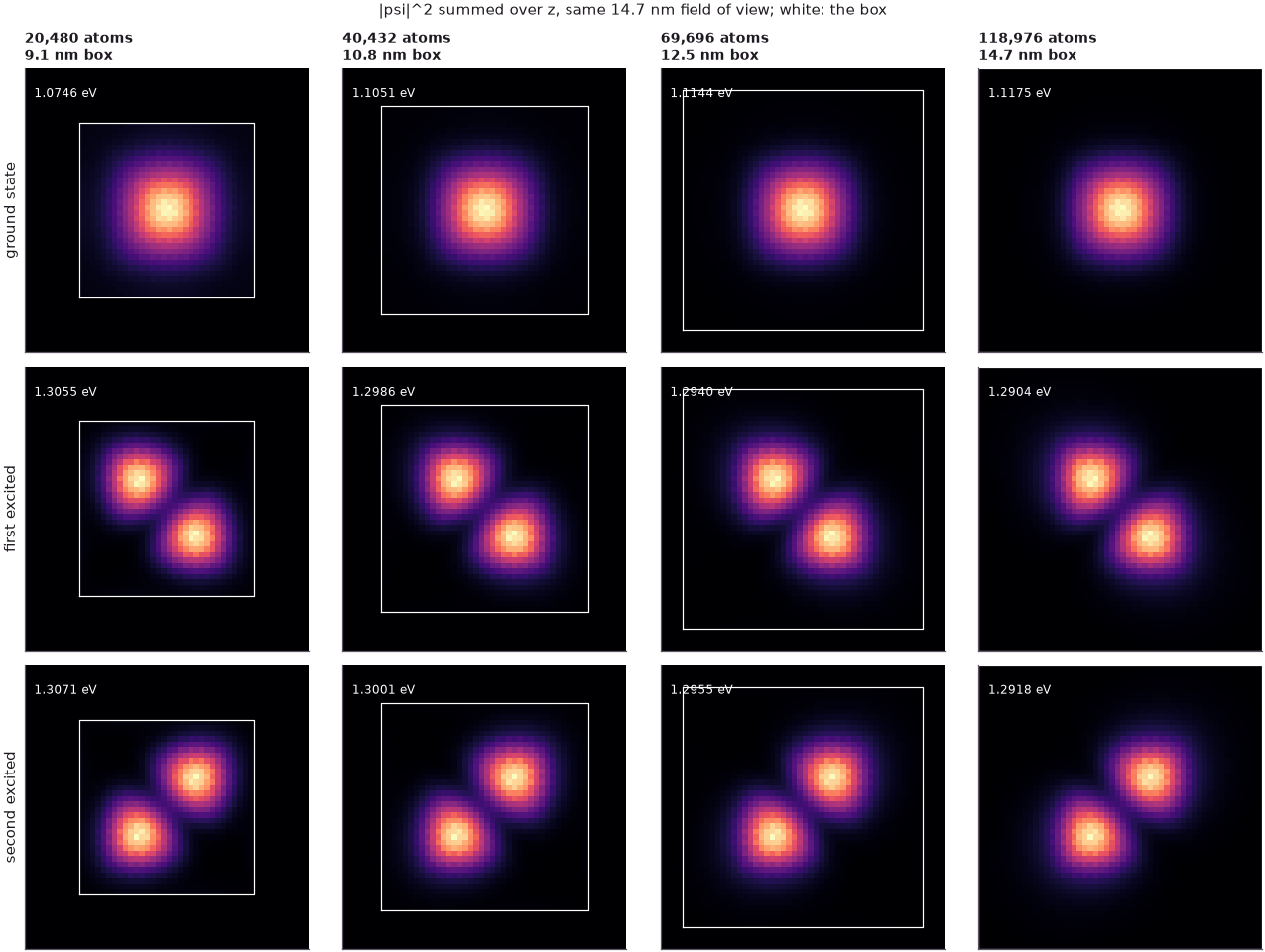
- Estimate how far inside the spectrum the dot states of an InAs dot in GaAs lie. - Repeat the test of slide 3 with open-nemo: one InAs pyramid in GaAs boxes of four sizes, from 20,480 to 118,976 atoms