

Section 03 · 8 lectures
Tunneling and band structure
Tunneling as a scattering problem and bands as its periodic limit: transfer matrices and where they lose precision, one barrier, two barriers and a resonance, N barriers turning into a band, the Kronig-Penney model solved graphically and numerically, and the group velocity, effective mass and holes that follow from a band.
ECE 606 Lecture 6.1
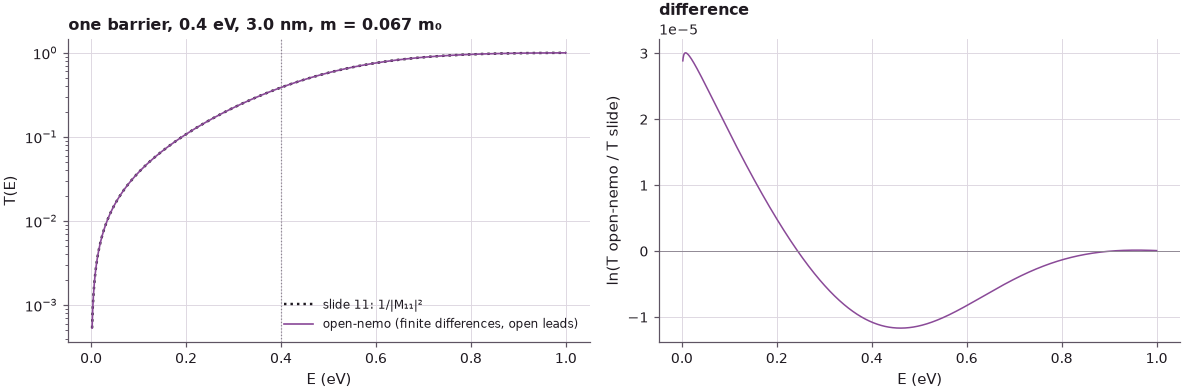
Electron tunneling — the transfer matrix method
builds the interface matrices of the slides in a few lines of numpy, checks them against a general transfer-matrix code, and compares both with open-nemo's transmission
Interactive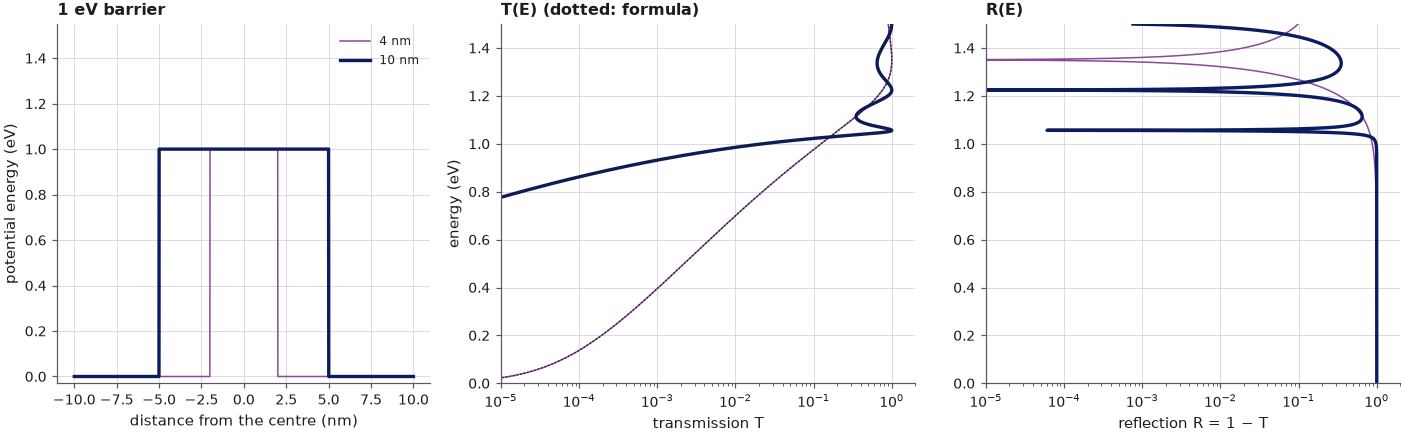
ECE 606 Lecture 6.2
Electron tunneling — tunneling through a single barrier
computes the lecture's PCPBT plots (transmission and reflection of a 1 eV barrier, 4 nm and 10 nm wide) with open-nemo, compares them with the exact formula and with its two limits, locates the above-barrier resonances
Interactive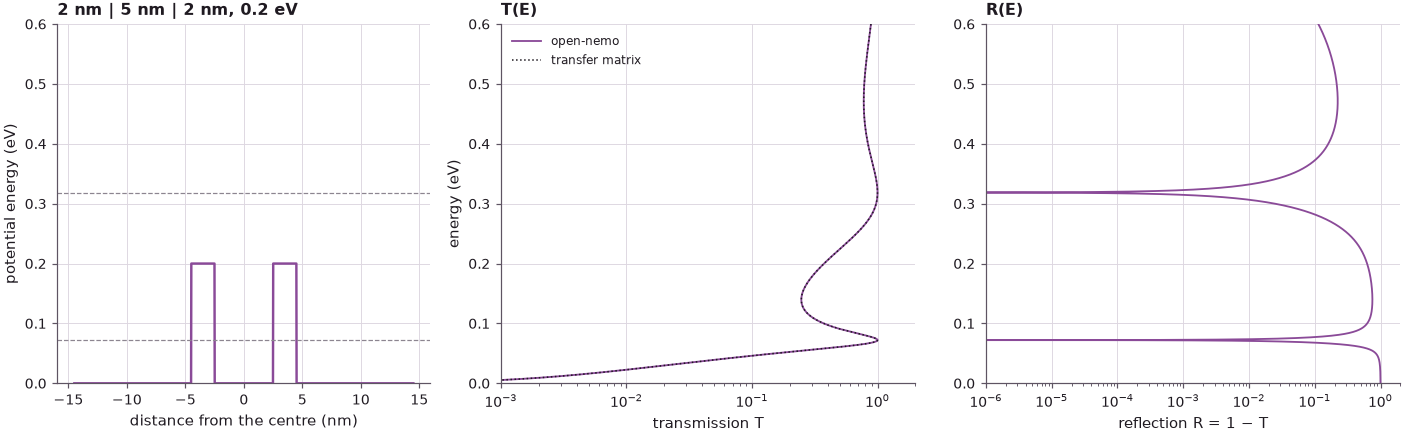
ECE 606 Lecture 6.3
Electron tunneling — tunneling through a double barrier
computes the lecture's PCPBT double-barrier examples with open-nemo, measures the resonance energies and widths (with nemo.resonances and from \(T(E)\)), converts them into lifetimes
ECE 606 Lecture 6.4
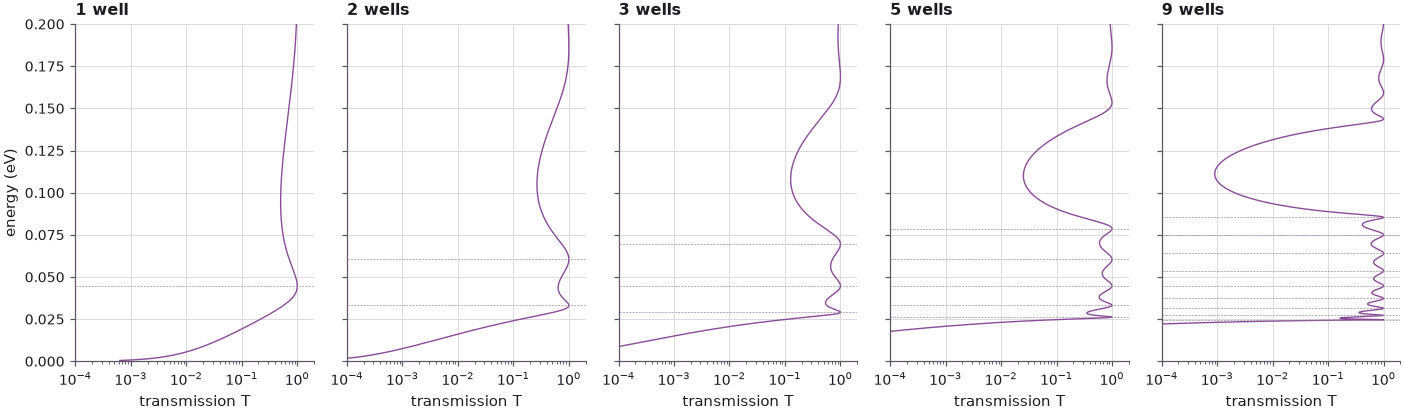
Electron tunneling — N barriers and the formation of bands
repeats the lecture's experiment with open-nemo for 1 to 49 wells, counts the transmission peaks, compares the peak energies with the Bloch band of the infinite superlattice, builds the two- and three-band structures
Interactive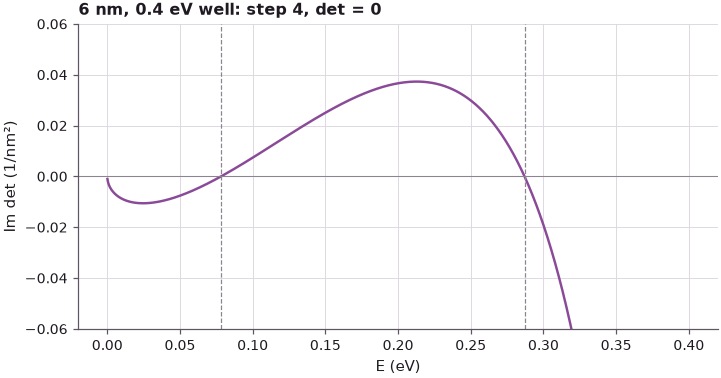
ECE 606 Lecture 6.5
Analytical and numerical solution strategies
solves a finite well with the five-step determinant, shows where the transfer matrix needs slicing and where it loses precision, builds the finite-difference Hamiltonian by hand and checks it against open-nemo's
Interactive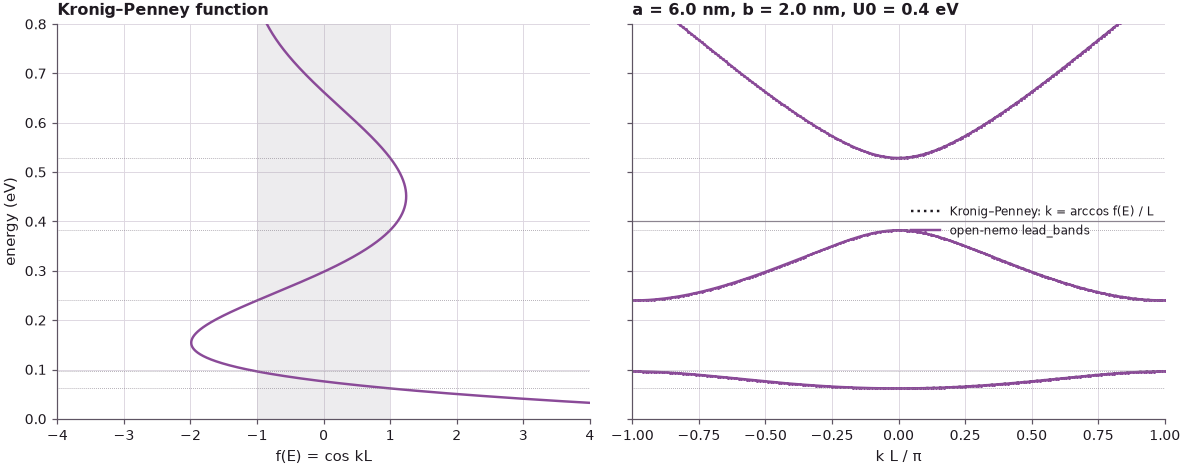
ECE 606 Lecture 7.1
Band structure in a periodic potential — problem formulation
builds a ring of identical cells with open-nemo's discretized Hamiltonian and shows that its eigenvalues are those of single-cell Bloch problems at \(k = 2\pi n/(NL)\)
Interactive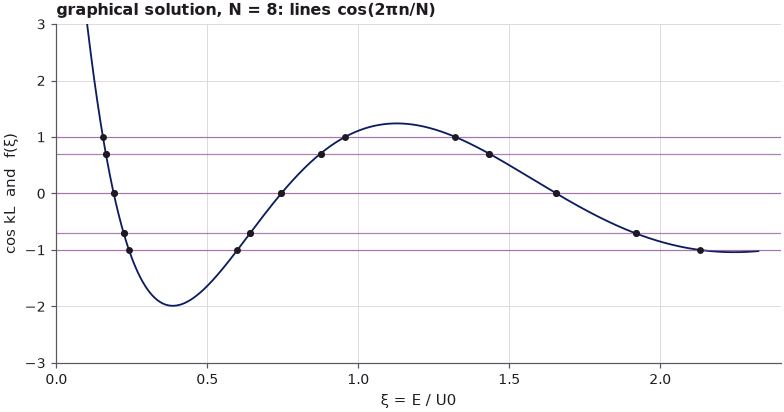
ECE 606 Lecture 7.2
Band structure in a periodic potential — solutions
solves the Kronig–Penney equation graphically and numerically, draws the bands in the reduced and extended zones, counts the states per band in rings of \(N\) cells
Interactive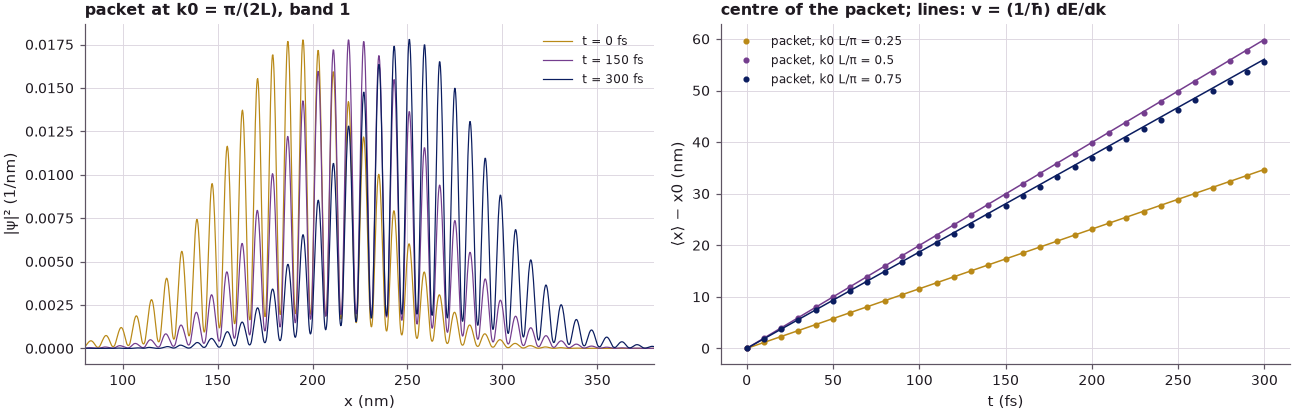
ECE 606 Lecture 7.3
Band properties: wave packets, effective mass, electrons and holes
computes the group velocity of the Kronig–Penney superlattice of Lectures 7.1 and 7.2 from open-nemo's band structure and checks it against wave packets propagated in time with open-nemo's Hamiltonian
Interactive